What is Rick Simpson Oil (RSO)?
Rick Simpson Oil is a concentrated, full-spectrum cannabis extract known for its high THC content and therapeutic potential. Developed by Rick Simpson in 2003, RSO has become one of the most sought-after cannabis extracts for wellness purposes.
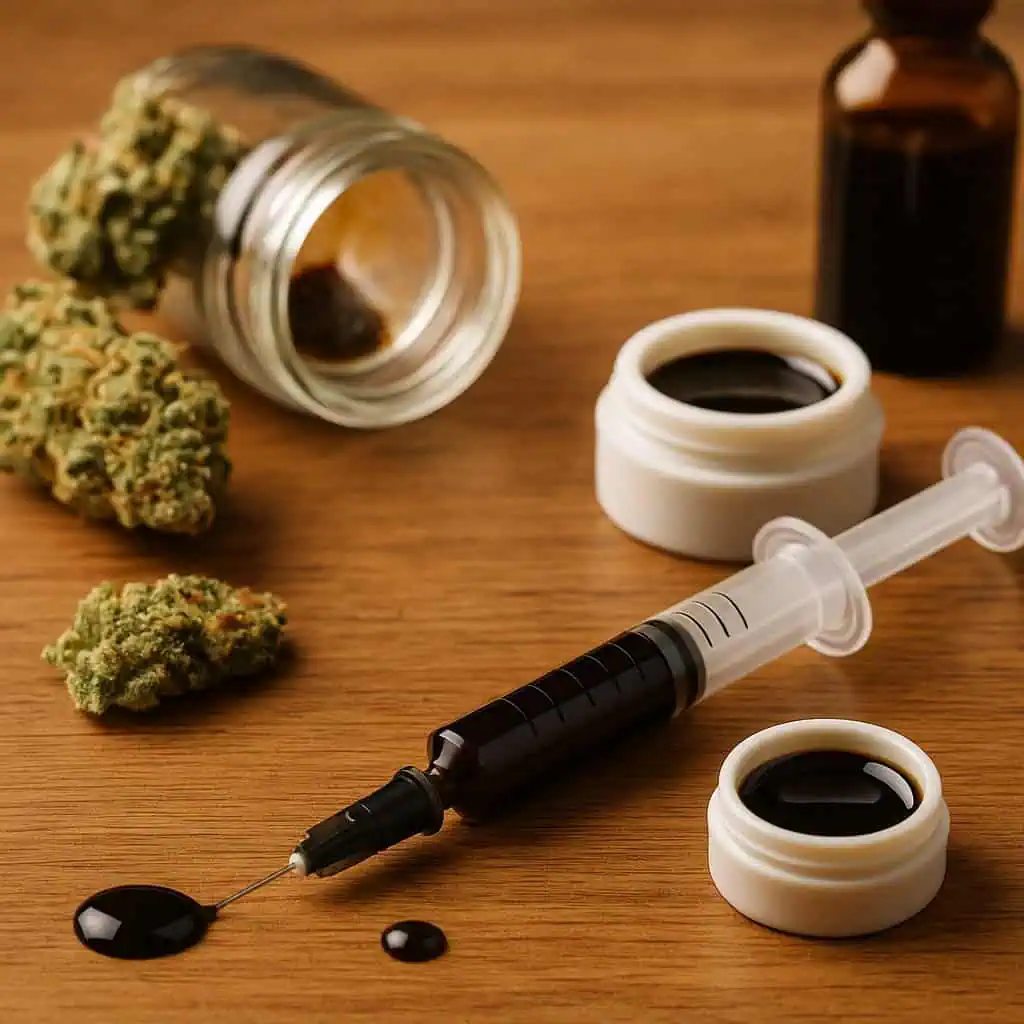
What Makes RSO Special
RSO stands out from other cannabis extracts due to its unique properties and production method.
Full Spectrum Extract
Contains all cannabinoids, terpenes, and beneficial compounds from the cannabis plant.
High Potency
Concentrated formula with 60-90% THC for maximum therapeutic effect.
Entourage Effect
Multiple compounds working synergistically for enhanced benefits.
Long-Lasting
Effects can last 4-8 hours when taken orally or sublingually.
How is RSO Made?
Traditional RSO is made using a solvent-based extraction process. Cannabis flower is soaked in a solvent (often food-grade ethanol) to dissolve the cannabinoids, terpenes, and other beneficial compounds.
The solution is then filtered and the solvent is carefully evaporated using low heat, leaving behind a thick, dark oil that contains the full spectrum of cannabis compounds.
Our RSO undergoes additional purification and testing to ensure the highest quality and safety standards are met, while preserving the beneficial compounds that make RSO so effective.
Extraction
Cannabis flower is soaked in food-grade ethanol
Filtration
Plant matter is removed, leaving cannabinoid-rich solution
Evaporation
Solvent is carefully removed using low heat
Testing
Third-party lab verification for potency and purity
How to Use RSO
RSO can be consumed in several ways, each with its own onset time and duration.
Oral Ingestion
PopularPlace on food or swallow directly. Effects take 1-2 hours to onset but last longest.
Sublingual
PopularHold under tongue for 60-90 seconds. Faster absorption than oral methods.
Topical Application
Apply directly to skin for localized relief. Does not produce psychoactive effects.
Suppository
Highest bioavailability method. Often used for serious conditions.
Start Low, Go Slow
RSO is highly potent. Always start with a very small dose (grain of rice size) and wait at least 2 hours before taking more. Gradually increase your dose over time as you learn how RSO affects you.
Understanding Cannabinoids
Cannabis contains over 100 cannabinoids, each with unique properties. The most abundant and well-researched are THC and CBD, but full-spectrum extracts contain beneficial minor cannabinoids as well.
THC (Tetrahydrocannabinol)
Psychoactive, pain relief, euphoria, creativity
60-90%
of RSO
The primary psychoactive cannabinoid that produces the 'high' associated with cannabis. THC interacts with CB1 receptors in the brain and central nervous system.
Key Benefits:
CBD (Cannabidiol)
Non-psychoactive, anxiety relief, anti-inflammatory
0-30%
of RSO
A non-intoxicating cannabinoid that modulates THC effects and provides therapeutic benefits without psychoactive effects. Works through multiple receptor systems.
Key Benefits:
CBN (Cannabinol)
Mild psychoactivity, sedation, sleep support
1-5%
of RSO
A minor cannabinoid with mild psychoactive effects that increases with cannabis age. Known for its strong sedative properties and sleep-inducing effects.
Key Benefits:
CBDA (Cannabidiolic Acid)
Anti-inflammatory, nausea relief, enzyme inhibition
1-10%
of RSO
The raw, acidic form of CBD found in fresh cannabis. CBDA converts to CBD when heated. Shows promise for anti-inflammatory and nausea management.
Key Benefits:
Terpenes: The Flavor & Effect Molecules
Terpenes are aromatic compounds that give cannabis its distinctive smell and contribute to its effects through the "entourage effect". They enhance and modulate cannabinoid effects.
| Terpene | Primary Effect | Aroma | Synergistic Action |
|---|---|---|---|
| Myrcene | Relaxation & Sedation | Earthy, herbal, musky | Enhances THC absorption, increases permeability across blood-brain barrier |
| Limonene | Mood Enhancement & Energy | Citrus, lemon, fresh | Elevates serotonin, provides antidepressant and anxiolytic effects |
| Pinene | Focus & Memory | Pine, herbal, fresh | Enhances memory retention, increases dopamine production |
| Linalool | Calming & Relaxation | Floral, lavender, sweet | Promotes relaxation, acts as natural anxiolytic and sedative |
| Caryophyllene | Anti-Inflammatory & Pain Relief | Spicy, peppery, warm | Unique CB2 receptor interaction, reduces inflammation without psychoactivity |
| Humulene | Appetite Suppression & Anti-Inflammatory | Hoppy, woody, spicy | Works synergistically with caryophyllene for enhanced effects |
Extraction Methods Explained
Different extraction methods preserve cannabinoids and terpenes in varying degrees. Understanding these methods helps you choose the right product for your needs.
Ethanol Extraction (RSO)
Solvent: Food-Grade Ethanol (Alcohol)
Temperature: Room Temperature - Low Heat
Time: 7-14 days soaking
THC Content: 60-90%
Advantages:
- ✓Full-spectrum preservation
- ✓Efficient extraction
- ✓Cost-effective
- ✓Traditional method
Considerations:
- ⚠Solvent residue possible
- ⚠Requires careful handling
- ⚠Longer processing
Solventless Extraction (FECO)
Solvent: None (Ice or Heat)
Temperature: Room Temperature
Time: 2-7 days
THC Content: 50-75%
Advantages:
- ✓No solvent residue
- ✓Ultra-pure final product
- ✓Maximum terpene retention
- ✓Premium quality
Considerations:
- ⚠Lower yield
- ⚠Higher cost
- ⚠More technical skill required
CO2 Extraction
Solvent: Supercritical CO2
Temperature: Low Temperature (35-60°C)
Time: 1-2 hours
THC Content: 40-80%
Advantages:
- ✓Precise control
- ✓No residue
- ✓Stable terpene preservation
- ✓Highly scalable
Considerations:
- ⚠Expensive equipment
- ⚠Higher cost per unit
- ⚠Requires expertise
The Endocannabinoid System
Your body naturally produces cannabinoids (endocannabinoids) that interact with a complex system of receptors throughout your nervous and immune systems. Cannabis compounds amplify and modulate these natural processes.
CB1 Receptors
Location:
Brain, Central Nervous System, Peripheral Nerves
Function:
Regulate mood, memory, appetite, pain sensation, motor control
Activation:
THC binding creates psychoactive effects
CB2 Receptors
Location:
Immune System, Gut, Organs, Immune Cells
Function:
Regulate immune response, inflammation, pain perception
Activation:
CBD and caryophyllene provide anti-inflammatory benefits
Anandamide
Location:
Throughout body
Function:
Endogenous cannabinoid (produced naturally), affects mood and pain
Activation:
Inhibited by CBD, enhanced by cannabis compounds
2-AG
Location:
Brain and Central Nervous System
Function:
Retrograde signaling, synaptic plasticity, immune regulation
Activation:
Works synergistically with plant cannabinoids
RSO FAQ
Who was Rick Simpson?
Rick Simpson is a Canadian engineer who developed RSO after using cannabis extract to treat his own skin cancer in 2003. He has since become an advocate for cannabis medicine and shared his extraction method freely.
How is RSO different from CBD oil?
RSO is a full-spectrum extract containing high levels of THC (60-90%) along with other cannabinoids. CBD oil typically contains little to no THC and focuses primarily on cannabidiol. RSO produces psychoactive effects while CBD oil does not.
What is the recommended dosage?
Start with a dose the size of a grain of rice (about 25mg). Wait 2-4 hours before taking more. Gradually increase over weeks as tolerance builds. The goal is to find your minimum effective dose.
Is RSO legal?
RSO legality depends on your location. It is legal in states/countries with medical or recreational cannabis programs. Always check your local laws before purchasing or using RSO.
Ready to Try RSO?
Explore our premium RSO products, all lab-tested and ready for delivery.